The Best Ways to Make Money With AI as a Beginner (4 Business Models That Actually Work)
If you’re a beginner and you’re asking, “What’s the best way to make money with AI?” the real answer is: pick one AI-friendly business model, commit to it for 60–90 days, and build volume.
Because right now, there’s a short window where AI gives beginners a serious unfair advantage. Not because it makes you “lucky,” but because it makes you fast: faster content production, faster product creation, faster testing, faster iteration.
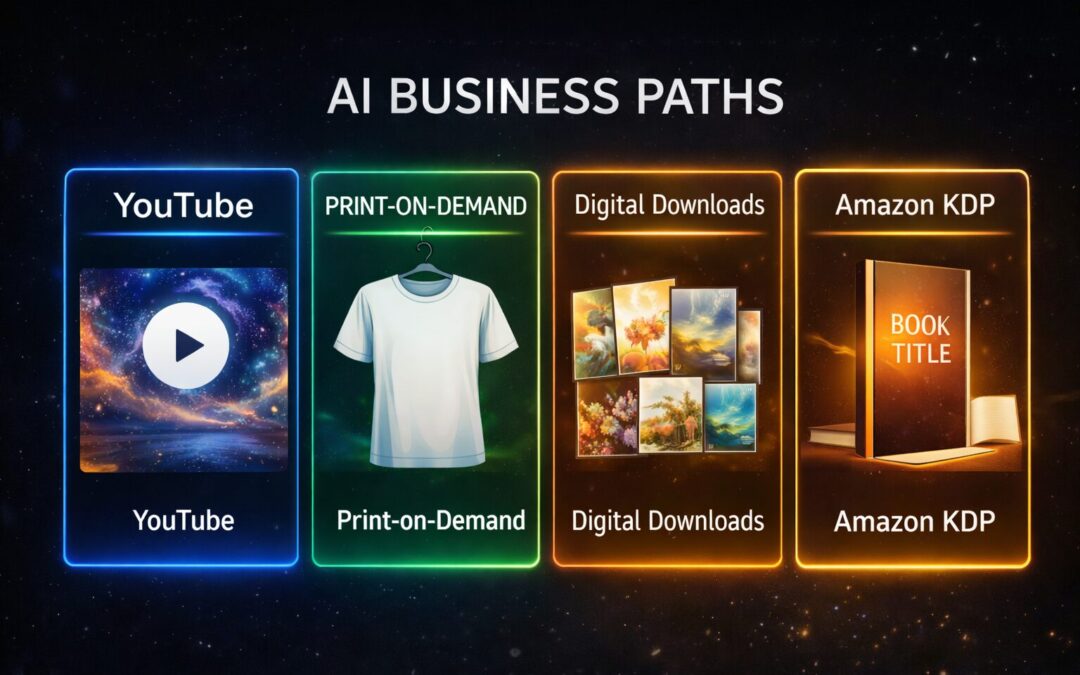
Below are four beginner-friendly AI businesses that can start earning relatively quickly—each with different skill requirements, startup costs, and income ceilings.
4 BEST AI Businesses To Start in 2026 (Beginner)
1) AI YouTube Channels (The “Content Compounding” Business)
YouTube is still one of the best businesses on the internet because your work stacks. A video you upload today can earn views for months or years, and every upload becomes another “asset” that can generate revenue.
The easiest AI YouTube format: “Screen Saver” Videos
These are the surprisingly popular videos where people play:
-
AI-generated artwork on a loop
-
seasonal or themed visuals
-
slow-changing or static imagery (sometimes for hours)
People use them for:
-
TV background ambience
-
desktop “screen savers”
-
mood/seasonal decoration
And yes—channels built entirely on this style can rack up serious monthly views, because the content is evergreen and repeatable.
Why it works
-
Extremely simple production
-
High output possible
-
View time is long (hours)
-
Each upload adds to a growing library
Tools commonly used
-
AI art generator (to produce themed images)
-
Basic video editor (to stitch images into long videos)
-
Optional voice tools if you do narration
Income potential
YouTube revenue is often estimated using RPM (revenue per 1,000 views). Generic channels can be lower RPM, but higher niches (like finance) can be much higher.
The bigger point: if you can build a catalog, this business becomes a compounding engine.
Best for: creators who want a scalable content business and can upload consistently.
2) Print-on-Demand With AI Designs (The “Real Business” Model)
Print-on-demand (POD) is a powerhouse because it combines:
-
online shopping demand
-
massive niche variety
-
zero inventory risk
-
scalable product catalog
How it works
You design a product (shirt, hoodie, mug, poster), list it online (Etsy, TikTok Shop, Amazon), and when someone buys it:
-
your supplier prints it
-
ships it
-
you keep the profit difference
Platforms like Printify make it easy because you don’t pay for inventory upfront.
Why AI makes POD easier than ever
Most POD designs are:
-
text-based
-
niche-based
-
style-based
-
simple graphics
AI helps you:
-
generate design concepts faster
-
create variations of winning styles
-
expand your catalog quickly
The 3 steps that matter
-
Niche research (find what already sells)
-
Design creation (AI helps a lot here)
-
Marketing/distribution (multiple channels)
This model is less “algorithm dependent” than social media because you can influence sales with:
-
product volume
-
listing optimization
-
marketplace strategy
Costs and upside
Startup costs are higher than YouTube, but still manageable:
-
you’ll likely spend $50–$100/month on tools and resources
The upside is also higher because you’re building a true product engine.
Best for: beginners who want predictable business mechanics and don’t mind learning marketplaces.
3) Selling AI Digital Downloads (The Highest Margin Model)
This is the closest thing to “selling pixels for profit.”
Digital downloads can include:
-
printable wall art
-
bundles of themed artwork
-
planners, trackers, worksheets
-
templates and kits
And because there’s no physical product:
-
no shipping
-
no inventory
-
minimal fulfillment
That’s why digital products can keep 90–95% profit margins after marketplace fees.
Why some shops scale fast
The winners in digital downloads usually do two things:
-
Pick a clear theme (style + niche + customer intent)
-
Build huge catalogs (hundreds or thousands of listings)
Most beginners quit too early at 30–50 listings.
The shops printing money don’t stop—they post volume.
The tradeoff
Digital downloads are “simple,” but:
-
competition is heavier
-
prompt quality matters more
-
you must export files correctly (print-ready sizing, resolution, formats)
Still, once a shop is built, this can become the most passive model of all four.
Best for: people who like design, don’t mind learning file formats, and can commit to catalog growth.
4) AI-Assisted Book Publishing (Amazon KDP + Custom Books)
Book publishing sounds intimidating, but it’s become beginner-friendly because of Amazon KDP (Kindle Direct Publishing).
What you can publish
-
low-content books (journals, trackers)
-
simple children’s books
-
themed storybooks
-
niche mini-guides
With AI, you can generate:
-
outlines
-
story drafts
-
illustrations
-
formatting assistance
The smartest angle: custom books
Customized storybooks (e.g., a child as the hero) can earn more per sale because they feel personal.
The tradeoff is they’re less passive because customization adds work.
Costs and income ceiling
This is often the cheapest to start:
-
low upfront costs
-
limited tooling needed
But income may cap faster unless you:
-
publish multiple books consistently
-
build multiple “micro-brands”
-
expand into higher-value formats
Best for: beginners who want the lowest barrier to entry and like publishing-focused work.
Which One Should You Pick?
Here’s the simplest way to choose:
Pick AI YouTube if you want:
-
compounding content
-
audience-based income
-
long-term evergreen growth
Pick Print-on-Demand if you want:
-
a real product business
-
predictable mechanics
-
multi-platform sales potential
Pick Digital Downloads if you want:
-
the highest margins
-
extreme passiveness
-
catalog-driven scale
Pick Book Publishing if you want:
-
lowest startup cost
-
straightforward production loop
-
potential to scale via volume
The Real Secret: Don’t Choose “Perfect.” Choose “Start.”
The advantage isn’t knowing everything.
The advantage is execution:
-
publish more than most people
-
test faster than most people
-
improve every week
-
build a catalog of assets (videos, products, designs, books)
AI doesn’t replace effort. It multiplies effort.