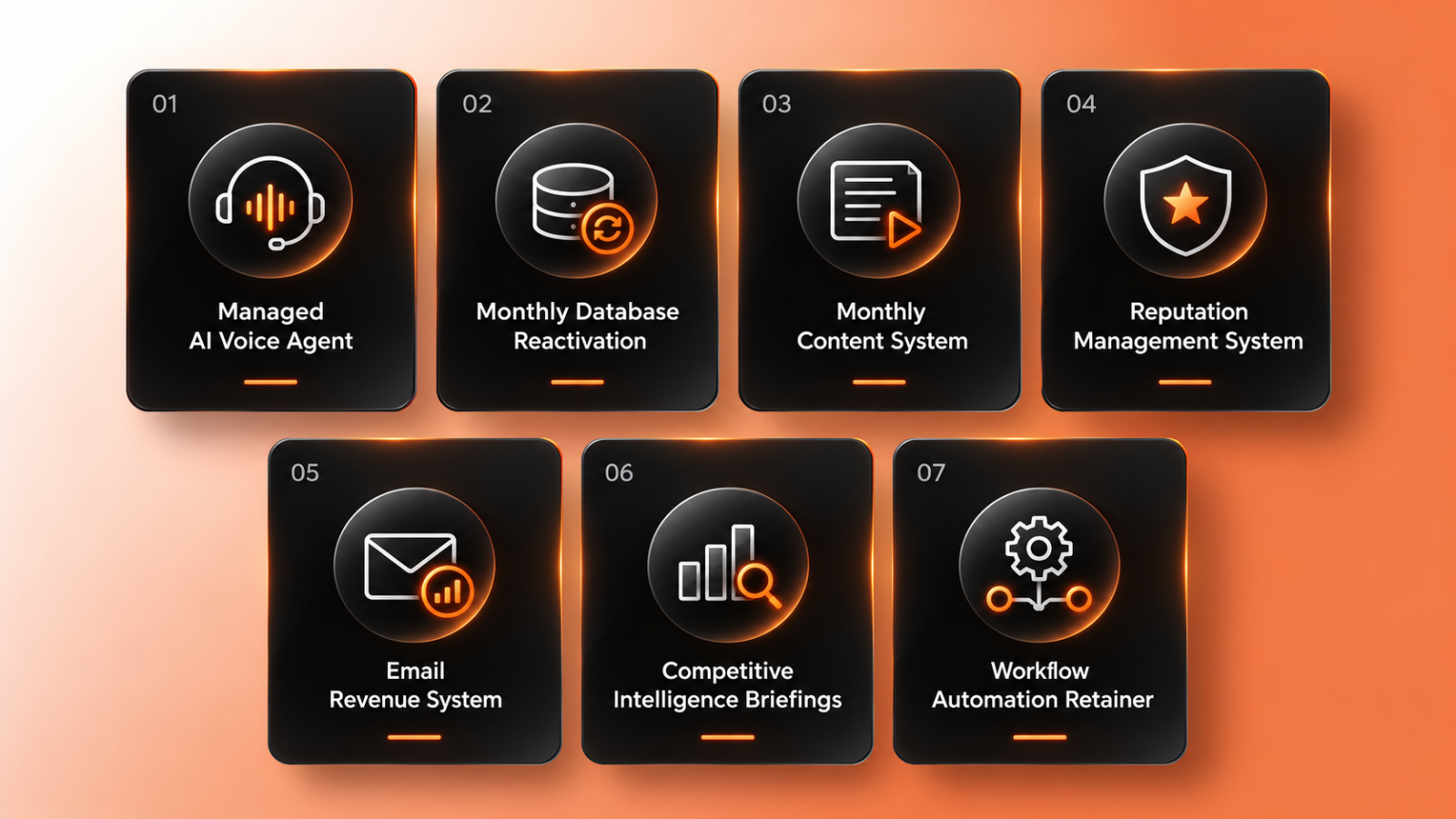
7 Claude-Powered Services You Can Sell for $997 a Month—Just You, No Team Required
The $997-a-Month AI Business: Seven Services Local Companies Could Keep Paying For
A local business owner doesn’t wake up thinking, “I need an AI agent.”
They wake up thinking about missed calls, unanswered inquiries, empty appointments, and another evening spent catching up on paperwork.
That gap between the technology people talk about and the problems businesses actually experience is where a practical AI service business can begin.
The opportunity is straightforward: find a recurring problem, build a reliable system to address it, and charge to keep it working.
At an illustrative price of $997 per month, five clients would generate $4,985 in monthly revenue, or $59,820 annually. That is gross revenue before software, usage fees, taxes, customer acquisition, and the time required to deliver the service.
The arithmetic is simple. Earning the retainer requires something more: a problem valuable enough to solve every month.
7 Claude Services You Can Sell for $997/Month (One Person, No Team)
Here are seven services that could fit that model—and what makes each worth considering.
1. Answer the calls that would otherwise become missed opportunities
Imagine a homeowner calling an air-conditioning company on a hot afternoon. The owner is working, the office is busy, and the call goes to voicemail.
The homeowner may leave a message. They may also call the next company.
A managed AI voice service can help answer routine questions, collect contact details, and request or book appointments within the business’s rules. An AI assistant such as Claude can help draft the knowledge base, conversation scripts, and escalation instructions. A connected voice platform and scheduling system handle the actual calls and bookings.
The ongoing work matters as much as the initial setup. Business hours change. Services change. Callers ask unexpected questions. Someone needs to review conversations, correct errors, and make sure difficult situations reach a person.
Consider a hypothetical business missing 10 calls per week. If one-quarter would have become $400 jobs, that represents approximately $4,000 in potential monthly revenue over four weeks. It is an estimate to investigate, not proof that an answering system will recover every dollar.
A useful monthly report distinguishes calls answered, qualified inquiries, appointments booked, and completed jobs. That gives the owner evidence they can evaluate.
2. Reconnect with leads the business already has
Many businesses have a second prospect list hiding inside their first one: people who showed interest and then disappeared.
Someone requested a quote but never booked. Someone attended an introductory session but never returned. Someone asked about membership and stopped responding.
Database reactivation starts by separating those contacts into meaningful groups. A recent inquiry deserves a different message from a former customer who has been absent for two years.
AI can help draft those messages. The service provider handles list quality, appropriate contact permissions, campaign setup, response routing, and measurement.
The numbers need careful interpretation. A list of 3,000 contacts with a 3% response rate produces 90 responses—not 90 customers. If 15 eventually became customers worth $1,200 each over a year, that would represent $18,000 in potential annual customer revenue, before costs.
The recurring opportunity comes from managing an evolving pipeline. New leads arrive, others become inactive, and offers change. Repeatedly messaging the same exhausted list is unlikely to create lasting value.
3. Build a content system with a business purpose
A business can publish every day and still struggle to explain what someone should do next.
A managed content service connects the publishing calendar to a specific objective: book consultations, fill a class, promote a seasonal service, or generate membership inquiries.
For a tennis club, that could mean a month of content built around beginner lessons. Posts might explain what to expect, introduce the coaches, answer equipment questions, and invite readers to register.
AI can help turn approved business information into drafts, captions, email copy, and video outlines. The provider supplies editorial judgment, verifies details, coordinates visuals, and schedules the finished material.
The monthly value comes from keeping the content accurate, relevant, and connected to current offers. Performance reporting should include inquiries and bookings where attribution is possible, alongside reach and engagement.
Publishing creates opportunities for discovery. It does not guarantee sales.
4. Turn customer reviews into useful business feedback
Reviews are public customer conversations. They also contain information owners may struggle to collect elsewhere.
A reputation management service monitors selected platforms, prepares thoughtful responses, escalates sensitive complaints, and identifies recurring themes.
AI can assist with drafting and grouping feedback. Human review helps ensure responses are accurate, appropriate, and consistent with the business’s voice.
A detailed complaint deserves more than a generic apology. It may require the owner’s attention, an operational fix, or a private follow-up.
The strongest monthly deliverable goes beyond a response count. It might reveal that customers consistently praise one employee, struggle with the booking process, or misunderstand a cancellation policy.
Pricing depends on scope. A small business receiving a handful of reviews may need a modest package. A larger operation with several locations, frequent feedback, and meaningful reporting requirements could justify a more substantial retainer.
5. Give email a clear job in the customer journey
Database reactivation focuses on dormant contacts. A broader email service supports customers throughout their relationship with the business.
That can include welcome messages, inquiry follow-ups, appointment reminders, introductory offers, renewal notices, and relevant invitations to return.
Each sequence should have a defined purpose. What happened? What does the recipient need? What action would help them take the next step?
AI can accelerate drafting, but someone still needs to manage targeting, timing, links, offer accuracy, deliverability, and results.
The monthly service should include continued improvement. Existing automations may keep running after their creator leaves; retaining the provider should be worthwhile because they monitor performance, update campaigns, and solve problems.
That is a healthier foundation for recurring revenue than making the client dependent on systems they cannot access.
6. Help owners understand their local competition
Business owners often know their competitors by name without having time to follow what they are doing.
A competitive intelligence briefing can track public offers, website changes, customer feedback, advertising messages, and positioning across a small group of relevant competitors.
AI can help organize and compare collected information. The provider must verify sources, record dates, and distinguish observations from interpretations.
The useful output is a decision.
If several nearby gyms emphasize low prices while customers repeatedly complain about crowding, a smaller gym might investigate whether coached sessions and predictable class sizes offer a stronger position.
A good briefing gives the owner a few supported findings and practical actions. Its value depends on the quality of the analysis and the decisions it informs—not the length of the report.
7. Remove repetitive steps from everyday operations
Workflow automation can become especially valuable because it addresses tasks employees encounter constantly.
Consider a new inquiry arriving through a website. Someone copies the details into a spreadsheet, sends an acknowledgment, alerts the right employee, and creates a follow-up reminder.
A connected workflow can perform those steps automatically, with checks for missing information and failures.
AI can help interpret an inquiry or draft a response. Conventional automation can move records, send notifications, and create tasks. Many useful systems combine both.
The ongoing service includes monitoring, troubleshooting, updating integrations, and improving workflows as the business changes.
If three separate tasks each consume one hour per workday, at $25 per hour over 20 working days, their combined labor equivalent is $1,500 per month. Whether that becomes actual savings depends on how much work is removed and how the freed time is used.
That distinction belongs in the sales conversation.
Start with one problem you can demonstrate
The temptation is to offer all seven services immediately. A more manageable starting point is one service for one type of business.
Talk to a handful of owners. Ask where inquiries get lost, what staff repeat every day, and which administrative task keeps getting postponed.
Look for a problem that appears repeatedly and has a measurable consequence.
Then build a small demonstration using sample data. Show the inquiry arriving, the follow-up happening, or the appointment being requested. Make the result easy to understand.
Outreach becomes more useful when it begins with a specific observation and a relevant example. A business owner can assess a working demonstration more easily than a broad promise to “transform operations with AI.”
Before quoting a monthly fee, define what it includes: setup, supported systems, usage limits, monitoring, reporting, and response expectations.
The $997 figure is a pricing example. The right price depends on the client’s needs, the service’s value, and the cost of delivering it reliably.
A durable AI service business grows from that reliability. Owners keep paying when the work remains useful, the results are visible, and the provider keeps earning their trust.